







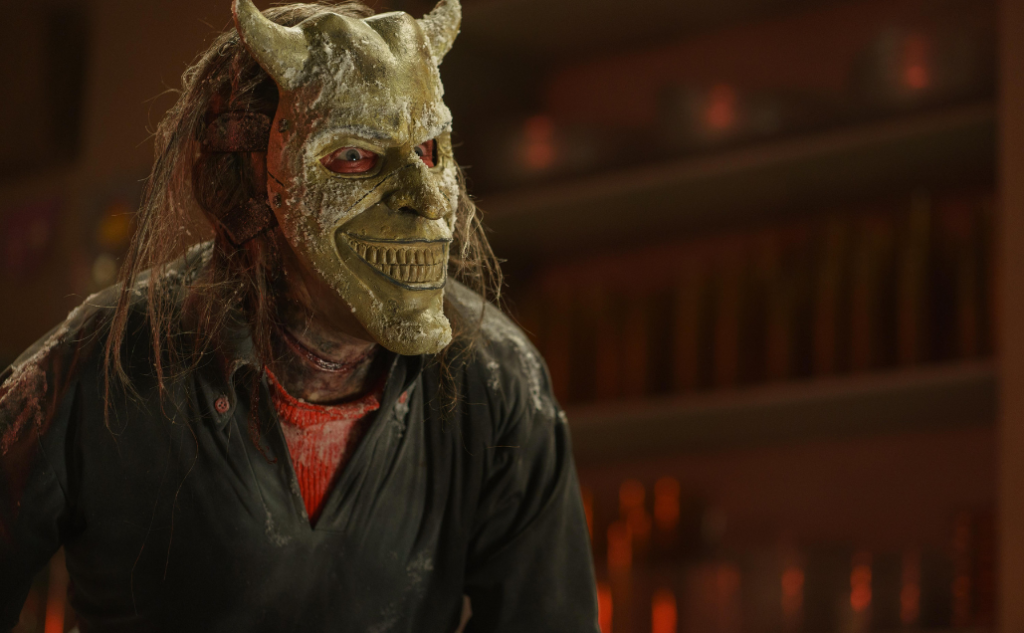
Despite strong performances from Mason Thames and Madeleine McGraw, the sequel abandons the psychological horror that made the original terrifying and turns the Grabber into a far less frightening presence.
Black Phone 2 Review: It mainly survives on the strength of its central cast and their character dynamics. The performances of Finn (Mason Thames) and Gwen (Madeleine McGraw) once again carry the emotional core of the story. Their characters pull us into a psychological space that feels more interesting than the actual horror the movie tries to create.
Finn’s arc is especially compelling. Even though the first film ended on a heroic note, the reality is that killing someone, whether it is a villain like the Grabber or not, leaves a mark. That kind of trauma doesn’t disappear. It lingers, and this movie tries to show how that experience continues to haunt Finn. It also affects his relationship with his sister Gwen, although I wish the film explored that tension much deeper.
If the story had built a stronger rift between Finn and Gwen, it could have elevated the main conflict significantly. Their strength as characters comes from the bond they share. Taking that emotional support away, even temporarily, could have made the narrative far more gripping. Because while Black Phone 2 has its positives, it never reaches the level of the original, and on its own the story doesn’t really stand out.
The Black Phone Review: This is the kind of horror that crawls under your skin and stays there.
Why The Grabber Isn’t Scary in Black Phone 2
I went into the film without big expectations, but I was still curious about one thing: how they were going to bring back the Grabber. Ironically, the character who was supposed to be the highlight of the sequel ends up being one of its weakest parts. The Grabber (Ethan Hawke), simply fails to be scary this time.
In the beginning there is some tension, some atmosphere that hints at the horror returning. But as the movie progresses, the fear fades away. Instead of becoming more terrifying, the character slowly turns into something almost laughable. And by the time the film reaches its ending, you might start wondering why this sequel needed to exist in the first place.
Review: We Bury the Dead (2025) Is Not the Zombie Film You Think It Is
Finn and Gwen’s Sibling Dynamic Remains the Heart of Black Phone 2
Grabber and the messy ending aside, if I only talk about Gwen and Finn, I think for them the movie is still worth watching. Both Mason Thames and Madeleine McGraw are phenomenal here. Their sibling dynamic was one of the best parts of The Black Phone, and in Black Phone 2 it remains the strongest element of the film.
You can clearly see that both of them care deeply about each other, but this time Finn is much more angry and aggressive. He starts behaving like a bully, constantly ignoring Gwen even when she is clearly going through her own struggles.
The reason behind it makes sense, he never really processes the trauma of what happened with the Grabber. Instead of dealing with it, he buries it inside and lets it come out in other ways: fighting in school, smoking, acting like someone you shouldn’t mess with. That tough exterior hiding a broken mind is something Mason Thames really nails in his performance.
Get Out— The Creepiest “Meet the Parents” Ever Made
Trades Psychological Horror for Gore And It Hurts the Film
Since the first movie leaned heavily into psychological horror, this sequel had the chance to go even deeper into that space. But instead it chooses the easier route that many horror movies take once they get a bigger budget — more gore, more ugliness, more visual brutality. And most of the time it felt more gross than horrifying.
What made the Grabber terrifying in the first film wasn’t the violence, it was the mystery and the psychological games he played with his victims. That slow build of fear, that haunting sense of the unknown that was the soul of The Black Phone. In this sequel, that element is mostly missing.
The more you think about the movie, the more loopholes start appearing. The way Black Phone 2 connects the story to the past gives the Grabber more of a haunting-entity presence, but it also removes the urgency. When you know that most of what you’re seeing already happened in the past, the immediate fear for the characters fades away.
In the first movie, even though we knew the previous victims were already dead through the phone calls and Gwen’s dreams, there was still a constant fear for Finn. The horror was in the game the Grabber played with his victims; the torture of the mind came long before the killing.
Here, that psychological grip is replaced with body horror and visual brutality, which didn’t work for me.
Plot Holes and Weak Stakes
The story could have been far more tense if Finn and Gwen were separated, forcing Gwen to face the Grabber’s wrath on her own. That isolation would have raised the stakes. Instead, Finn is present in almost every major moment, which prevents Gwen from ever feeling truly vulnerable. Ironically, what should have been Gwen’s movie ends up turning Finn back into the central hero again.
The cabin setting in the second half even reminded me of The Quarry. And honestly, after watching this film my respect for that game’s story increased, at least there the stakes actually felt high. Here, even when characters witness something horrifying, their reactions feel strangely casual, which constantly pulls you out of the experience.
One of the biggest logical gaps is Finn being able to physically grab the Grabber even though he can’t see him and the film treats him like an entity. The movie blurs the line between killing a human and defeating a supernatural presence, as if both work the same way — and that confusion ultimately ruins the ending.
Sound Visuals And Style
Still, in the technical department the movie stands out. The dream sequences, especially the grainy visual style, look fantastic. That was already one of the most memorable aspects of the first film, and here they push it further through Gwen’s sleepwalking and dream-walking moments. This time she isn’t just observing visions, the dreams start affecting her directly.
The sound design and background score are also strong. The wide, isolated shots combined with sudden intimate zoom-ins place you directly inside the characters’ perspective and help build the atmosphere the movie often struggles to create through its story.
Cast and Characters I Liked and Didn’t Like
Ethan Hawke as The Grabber did nothing wrong in terms of performance. His body language, voice, creepy playfulness, and looming presence are still impossible to ignore. But despite that, I didn’t enjoy the Grabber here as much as I did in The Black Phone. And the blame goes entirely to the writing and screenplay.
In the first film, the Grabber was terrifying because he was human yet still felt unstoppable. In Black Phone 2, when he returns more like an entity, he should have been even more threatening, someone literally unkillable and undefeated. Instead, the movie defeats him far too easily, which honestly feels like an injustice to such a popular character.
The first movie became iconic largely because of the Grabber, yet in this sequel he never truly feels like the central force of the story. Ironically, the movie might have worked better if the narrative leaned more into his perspective rather than focusing mostly on Gwen and Finn.
Among the new characters, only Mando (Demian Bichir), stood out to me. His character actually had an arc and helped move the story forward. The other new characters didn’t leave much impact. Mustang, (Arianna Rivas) was good as a performer but the character itself felt wasted. She had potential to become important to the story, yet the film barely used her.
Another character that could have added depth was Barbara, played by Maeve Beaty. The movie could have hinted that she shared some deeper history with Bill and had always been suspicious of him. If the revelation about Bill given by Gwen and Finn had pulled her into the conflict as some kind of reluctant partner in uncovering the truth, the third act might have felt much stronger and more intense.
Miguel Mora was fantastic in the first movie and again stands out here. In the original he had the energy of a main character even in a supporting role. In this sequel, since the story leans more toward Gwen, he works perfectly as her emotional support; someone who may not fully understand what she’s going through but is always there to listen. And honestly, he looked like a book character who just stepped onto the screen — fictional-level handsome in this one.
I enjoyed the small romantic moments between Ernesto and Gwen. They were simple but added a bit of warmth to an otherwise dark story.
Black phone 2 Review Conclusion
If you really loved The Black Phone, you will probably still enjoy Black Phone 2 because of the returning cast and the way the story connects the past to Gwen and Finn’s mother. That part is actually an interesting direction.
Yes, the movie has plenty of loopholes, but if you don’t think too deeply about them, it can still work as a fun one-time watch. Just don’t expect it to reach the same level as its predecessor — because unlike the first film, this one doesn’t really bring anything new to the table.
Don’t just scroll by, lock in bucketfulent.com like it’s your digital BFF. Bookmark it, slap it on your speed dial, tattoo it on your browser if you must, because if you lose us, we lose you, and that’s a tragedy we’re not ready for. Unleash this content on your friends like confetti at a surprise party.